What Is a Roth IRA? (2026)
A Roth IRA is an individual retirement account you fund with after-tax money, where your investments grow tax-free and qualified withdrawals in retirement are completely tax-free. You do not get a tax break when you put money in, but you never pay tax on the growth or on what you take out later. That trade, pay tax now to skip it forever, is what makes the Roth so powerful, especially if you are young or expect higher taxes down the road. (Source: IRS retirement contribution limits)
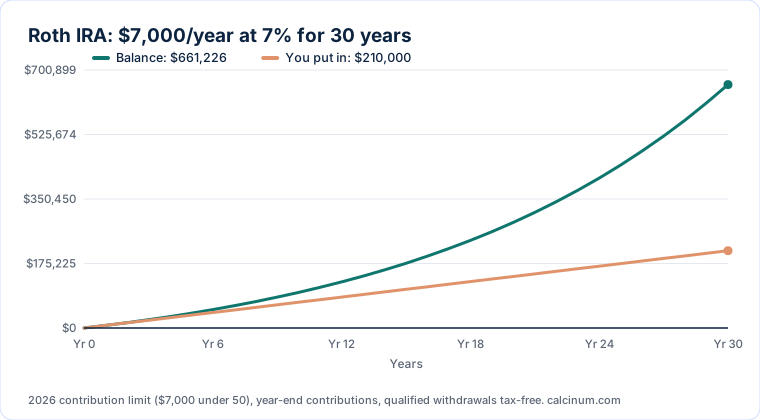
2026 contribution limits
| Limit (2026) | Amount |
|---|---|
| Under age 50 | $7,500 |
| Age 50+ (with catch-up) | $8,600 |
This is the combined limit across all your IRAs (traditional and Roth together). You can contribute for a given tax year up until that year’s tax-filing deadline.
Income limits
Roth IRAs have income caps. For 2026, your ability to contribute phases out at:
- Single / head of household: $153,000 to $168,000 of modified AGI.
- Married filing jointly: $242,000 to $252,000.
Above those ranges you cannot contribute directly (though a “backdoor Roth” strategy exists for higher earners).
Why people love the Roth IRA
- Tax-free growth and withdrawals. Decades of gains come out untaxed in retirement.
- No required minimum distributions (RMDs). Unlike a traditional IRA or 401(k), a Roth IRA never forces you to withdraw, so it can keep growing or pass to heirs.
- Flexible access to contributions. You can withdraw the money you contributed (not the earnings) at any time, tax- and penalty-free, a built-in backup.
- Great for young savers. When your tax rate is likely lower now than in the future, paying tax today is a bargain.
The qualified-withdrawal rules
To take earnings out tax-free, two things generally must be true: you are at least 59½, and the account has been open at least five years (the “5-year rule”). Withdraw earnings before that and you may owe tax and a 10% penalty, though contributions always come out freely.
Roth IRA vs. Roth 401(k)
Both use after-tax money for tax-free growth. The 401(k) version has much higher limits and an employer match but fewer investment choices; the IRA has lower limits but more flexibility. Neither has RMDs during your lifetime any more: SECURE 2.0 ended them for Roth 401(k)s from 2024. Many people use both.
Bottom line
- A Roth IRA is funded with after-tax dollars; growth and qualified withdrawals are tax-free.
- 2026 limit: $7,500 ($8,600 if 50+), with income phase-outs starting at $153K single / $242K married.
- Highlights: no RMDs, contributions withdrawable anytime, and it is ideal when you expect higher future taxes.
Project your Roth growth with our Roth IRA calculator, or compare account types with the Roth vs traditional 401(k) calculator. This article is general information, not investment or tax advice.
Related Calculators
Related articles

Rakesh Choudhary, PhD · Founder & Editor
Rakesh Choudhary, PhD, is the founder of Calcinum. A sociologist by training, he builds every calculator on the site and maintains its 2026 federal and state tax data, sourced from primary references (IRS, SSA, state revenue departments, DFAS) and re-verified whenever the law changes. Tax data is sourced from primary references (IRS, state revenue departments, SSA, DFAS) and re-verified annually each tax year.
Editorial standards: Our tax and financial figures come from primary sources — the IRS, SSA, and state revenue departments — and are reviewed against the current tax year before publication. See our full methodology & accuracy for our sourcing and review process.
Not financial advice: This article is for general informational purposes only. Calcinum does not provide regulated tax, legal, or investment advice. Consult a qualified professional for decisions specific to your situation.