How Much Do I Need to Retire? (2026)
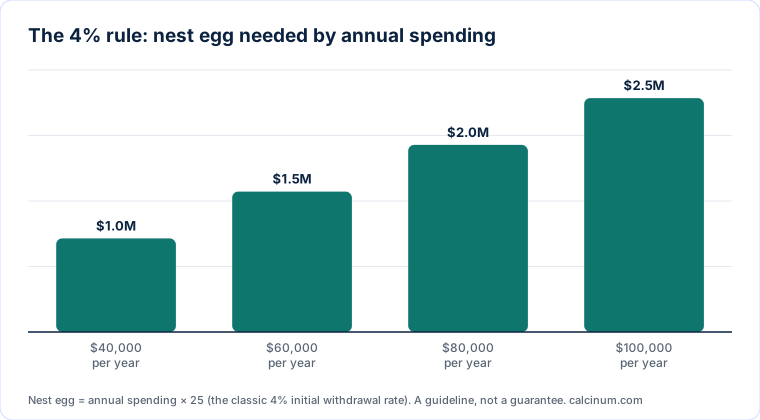
A widely used rule of thumb is that you need about 25 times your annual expenses saved to retire. If you expect to spend $60,000 a year, that points to roughly $1.5 million. This comes from the 4% rule, the idea that you can withdraw about 4% of your portfolio in the first year of retirement, adjust it for inflation each year after, and have a high chance of the money lasting 30 years. It is a starting estimate, not a guarantee, but it is the simplest way to get a target. The rule comes from studies of past US market returns; no government agency sets or endorses it.
Two ways to estimate your number
1. The 25x expenses method (4% rule). Add up your expected annual spending in retirement, then multiply by 25.
| Annual spending | Target portfolio (25x) |
|---|---|
| $40,000 | $1,000,000 |
| $60,000 | $1,500,000 |
| $80,000 | $2,000,000 |
| $100,000 | $2,500,000 |
2. The income-replacement method. A common guideline is that you need 70% to 85% of your pre-retirement income each year, because some costs (commuting, payroll taxes, saving for retirement) disappear. If you earn $100,000 now, plan for roughly $70,000 to $85,000 a year in retirement.
What lowers the number you need to save
Your portfolio does not have to cover 100% of your spending. Other income sources reduce the target:
- Social Security. The average benefit replaces a meaningful share of income, more for lower earners. Subtract your estimated annual benefit from the spending your savings must cover.
- Pensions (including military or government plans).
- Part-time work in early retirement.
Example: if you spend $60,000 a year but expect $24,000 from Social Security, your savings only need to cover $36,000, which is 25 x $36,000 = $900,000, not $1.5 million.
What raises it
- Retiring early. Retiring at 50 means funding more years and bridging to Medicare at 65, so early retirees often use a more conservative 3% to 3.5% withdrawal rate (which means saving more, closer to 28x to 33x expenses).
- Healthcare and long-term care, which tend to rise faster than general inflation.
- A long retirement. Planning to age 95+ requires a bigger cushion.
The 4% rule, with a caveat
The 4% rule came from historical US market data and assumes a balanced stock-and-bond portfolio. It has held up well, but it is not ironclad: a severe market drop early in retirement (sequence-of-returns risk) can strain it. Many planners now treat 4% as a reasonable starting point and stay flexible, trimming spending in down years.
Bottom line
- Start with 25 x your annual expenses (the 4% rule), or 70% to 85% of your income.
- Subtract Social Security and pensions to find what your savings actually need to cover.
- Retiring early or planning a long retirement pushes the number higher.
Project your own path with our FIRE calculator and 401(k) calculator, and track progress with the net worth calculator. This article is general information, not financial advice.
Related Calculators
Related articles

Rakesh Choudhary, PhD · Founder & Editor
Rakesh Choudhary, PhD, is the founder of Calcinum. A sociologist by training, he builds every calculator on the site and maintains its 2026 federal and state tax data, sourced from primary references (IRS, SSA, state revenue departments, DFAS) and re-verified whenever the law changes. Tax data is sourced from primary references (IRS, state revenue departments, SSA, DFAS) and re-verified annually each tax year.
Editorial standards: Our tax and financial figures come from primary sources — the IRS, SSA, and state revenue departments — and are reviewed against the current tax year before publication. See our full methodology & accuracy for our sourcing and review process.
Not financial advice: This article is for general informational purposes only. Calcinum does not provide regulated tax, legal, or investment advice. Consult a qualified professional for decisions specific to your situation.