How Much Should I Contribute to My 401(k)? (2026)
Contribute at least enough to get your full employer match, then work toward saving 15% of your income, and max out the account if you can. Those three benchmarks, the match, 15%, and the annual limit, answer the question for almost everyone. The 2026 limit is $24,500 (plus an $8,000 catch-up if you are 50 or older, for $32,500 total). (Source: IRS retirement contribution limits)
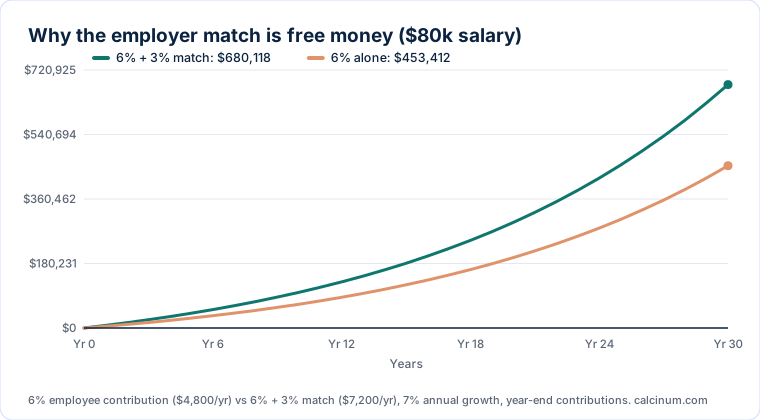
Step 1: Always get the full match
If your employer matches contributions (say, 100% of the first 4% or 50% of the first 6%), contribute at least enough to capture all of it. The match is an immediate, guaranteed return, often a 50% to 100% gain on those dollars, that you cannot get anywhere else. Not contributing enough to get the full match is leaving free money on the table.
Step 2: Aim for 15% of your income
A widely used benchmark is to save 15% of your gross income for retirement, including the employer match. So if your employer adds 4%, you contribute 11% to reach 15%. Starting in your 20s, even 10% to 15% has decades to compound; starting later, you may need to push higher to catch up.
Step 3: Max it out if you can
If you have the match, an emergency fund, and high-interest debt under control, the next move is to max the account:
| 2026 401(k) limit | Amount |
|---|---|
| Standard (under 50) | $24,500 |
| Age 50+ catch-up | + $8,000 ($32,500 total) |
| Ages 60–63 catch-up | + $11,250 ($35,750 total) |
Maxing out is not realistic for everyone, and that is fine. The match and the 15% target matter far more than hitting the cap.
A rough guide by situation
- Just starting / tight budget: contribute up to the full match, then raise it 1% each year.
- Comfortable: target 15% including the match.
- High earner / catching up: max the limit, and consider an IRA on top.
Traditional or Roth?
- Traditional 401(k): contributions lower your taxable income now; you pay tax on withdrawals in retirement. Often better if you expect a lower tax rate later.
- Roth 401(k): contributions are after-tax, but withdrawals are tax-free. Often better if you are young or expect higher taxes later.
Many people split between the two to hedge.
Bottom line
- Floor: enough to get the full employer match, always.
- Target: 15% of income, including the match.
- Ceiling: $24,500 in 2026 ($32,500 with the 50+ catch-up).
See how your contributions grow with our 401(k) calculator, and compare account types with the Roth vs traditional 401(k) calculator. This article is general information, not financial advice.
Related Calculators
Related articles

Rakesh Choudhary, PhD · Founder & Editor
Rakesh Choudhary, PhD, is the founder of Calcinum. A sociologist by training, he builds every calculator on the site and maintains its 2026 federal and state tax data, sourced from primary references (IRS, SSA, state revenue departments, DFAS) and re-verified whenever the law changes. Tax data is sourced from primary references (IRS, state revenue departments, SSA, DFAS) and re-verified annually each tax year.
Editorial standards: Our tax and financial figures come from primary sources — the IRS, SSA, and state revenue departments — and are reviewed against the current tax year before publication. See our full methodology & accuracy for our sourcing and review process.
Not financial advice: This article is for general informational purposes only. Calcinum does not provide regulated tax, legal, or investment advice. Consult a qualified professional for decisions specific to your situation.