How to Pay Off Debt Fast (2026)
The fastest way to pay off debt is to throw every extra dollar at one balance at a time while making minimum payments on the rest. There is no magic trick, but a clear method turns a vague pile of debt into a finish line you can actually reach. Here is the step-by-step plan.
Step 1: List every debt
Write down each debt with its balance, interest rate, and minimum payment. You cannot make a plan until you see the whole picture. This includes credit cards, student loans, car loans, medical bills, and anything in collections.
Step 2: Free up extra money
Paying off debt fast requires finding extra cash to put toward it:
- Cut expenses temporarily (subscriptions, dining out, unused memberships).
- Add income with overtime, a side gig, or selling unused items.
- Pause extra savings beyond your emergency fund and employer 401(k) match while you attack high-interest debt.
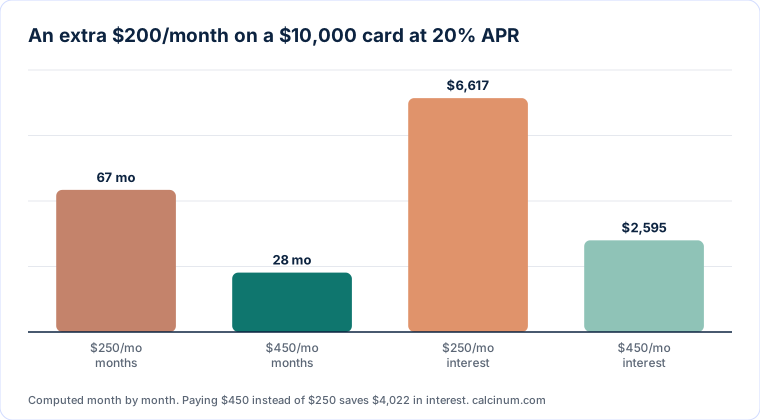
Even an extra $200 a month dramatically shortens the timeline.
Step 3: Pick a payoff method
Two proven strategies, both make minimum payments on everything and put all extra money toward one target debt:
| Method | Target order | Best for |
|---|---|---|
| Avalanche | Highest interest rate first | Saving the most money and time |
| Snowball | Smallest balance first | Quick wins and staying motivated |
The avalanche is mathematically optimal, you pay the least interest. The snowball gives you a fast first victory, which keeps many people going. Either beats spreading extra money thinly across all debts. (See debt snowball vs. avalanche for a full comparison.)
Step 4: Attack, then roll it forward
Once the first debt is gone, take its entire payment (minimum plus extra) and add it to the next target. Each payoff makes the next one faster, the “snowball” effect that builds momentum.
Tools that can speed things up
- Balance transfer card: move high-interest credit card debt to a 0% intro-APR card and pay it down interest-free during the promo period. Watch for transfer fees.
- Debt consolidation loan: combine several debts into one lower-rate loan with a single payment. Only helps if the new rate is genuinely lower.
- Negotiate: for medical bills or collections, ask for a payment plan or a settlement.
Step 5: Stop the bleeding
None of this works if new debt keeps appearing. Pause new credit card spending, build a small starter emergency fund ($1,000) so surprises do not go on a card, and switch to cash or debit while you pay things off.
Bottom line
- List your debts, free up extra money, pick snowball or avalanche, and roll each payoff into the next.
- High-interest debt first (avalanche) saves the most; smallest balance first (snowball) keeps you motivated.
- Use balance transfers or consolidation only when they truly lower your rate.
Build your payoff plan with our debt snowball calculator or credit card payoff calculator, and find the extra cash with the budget calculator. This article is general information, not financial advice.
Related Calculators
Related articles

Rakesh Choudhary, PhD · Founder & Editor
Rakesh Choudhary, PhD, is the founder of Calcinum. A sociologist by training, he builds every calculator on the site and maintains its 2026 federal and state tax data, sourced from primary references (IRS, SSA, state revenue departments, DFAS) and re-verified whenever the law changes. Tax data is sourced from primary references (IRS, state revenue departments, SSA, DFAS) and re-verified annually each tax year.
Editorial standards: Our tax and financial figures come from primary sources — the IRS, SSA, and state revenue departments — and are reviewed against the current tax year before publication. See our full methodology & accuracy for our sourcing and review process.
Not financial advice: This article is for general informational purposes only. Calcinum does not provide regulated tax, legal, or investment advice. Consult a qualified professional for decisions specific to your situation.