How Much Should I Have in Savings? (2026)
Your first savings goal is an emergency fund of 3 to 6 months of expenses; after that, the benchmarks shift to long-term retirement savings. “How much should I have saved” really has two answers depending on the goal: short-term safety (cash in the bank) and long-term wealth (invested for retirement). Here is how much to aim for at each. (Source: FDIC deposit insurance)
Goal 1: Emergency fund (cash)
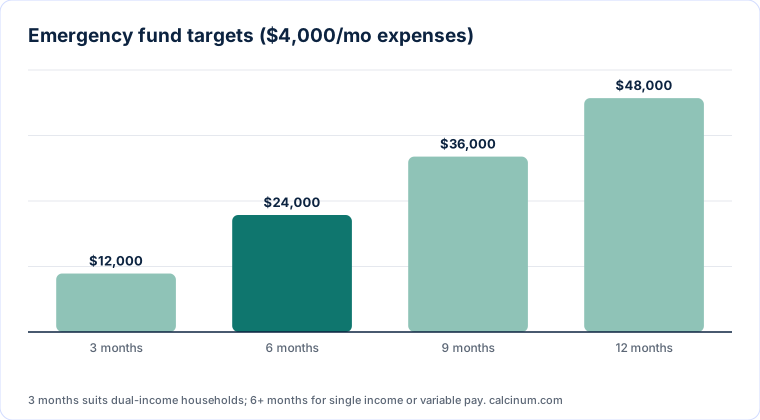
Before anything else, build a cushion of 3 to 6 months of essential expenses in a high-yield savings account:
- 3 months if you have stable income and few dependents.
- 6 months (or more) if your income is variable, you are self-employed, or you support a family.
If $4,000 a month covers your essentials, target $12,000 to $24,000. Start with a $1,000 starter fund, then build from there.
Goal 2: Retirement savings by age
For long-term savings, a widely cited set of benchmarks (popularized by Fidelity) targets a multiple of your annual salary, invested for retirement:
| By age | Target saved (× salary) |
|---|---|
| 30 | 1× |
| 40 | 3× |
| 50 | 6× |
| 60 | 8× |
| 67 | 10× |
So someone earning $60,000 would aim for about $60,000 saved by 30, $180,000 by 40, and roughly $600,000 by 67. These are guideposts, not hard rules, starting late or saving aggressively shifts the picture.
Savings to buy a house
Buying adds a separate target: enough for a down payment plus closing costs. You do not need 20% (loans go as low as 3% to 3.5% down), but more down means a lower payment and no PMI. Budget another 2% to 5% of the price for closing costs, and keep your emergency fund intact on top of it.
How to hit these numbers
- Automate it. Move money to savings the day you get paid, before you can spend it.
- Use the right account. Keep the emergency fund in a high-yield savings account; invest retirement money in a 401(k) or IRA.
- Get the employer match before chasing other goals, it is free money toward the retirement benchmark.
Bottom line
- First: 3 to 6 months of expenses in cash for emergencies.
- Then: retirement savings toward 1× salary by 30, 3× by 40, 10× by 67.
- House: a separate down-payment fund on top, without raiding the emergency cushion.
Size your emergency fund with our emergency fund calculator and track total progress with the net worth calculator. This article is general information, not financial advice.
Related Calculators
Related articles

Rakesh Choudhary, PhD · Founder & Editor
Rakesh Choudhary, PhD, is the founder of Calcinum. A sociologist by training, he builds every calculator on the site and maintains its 2026 federal and state tax data, sourced from primary references (IRS, SSA, state revenue departments, DFAS) and re-verified whenever the law changes. Tax data is sourced from primary references (IRS, state revenue departments, SSA, DFAS) and re-verified annually each tax year.
Editorial standards: Our tax and financial figures come from primary sources — the IRS, SSA, and state revenue departments — and are reviewed against the current tax year before publication. See our full methodology & accuracy for our sourcing and review process.
Not financial advice: This article is for general informational purposes only. Calcinum does not provide regulated tax, legal, or investment advice. Consult a qualified professional for decisions specific to your situation.