Why Is My Paycheck So Low? (2026)
Your paycheck is smaller than your salary because of taxes and deductions that come out before you ever see the money. A common rule of thumb: expect to take home roughly 70% to 80% of your gross pay after federal tax, state tax, Social Security, Medicare, and benefits. If yours feels even lower than that, one of the reasons below is usually the cause. (Source: IRS Publication 15 (Circular E))
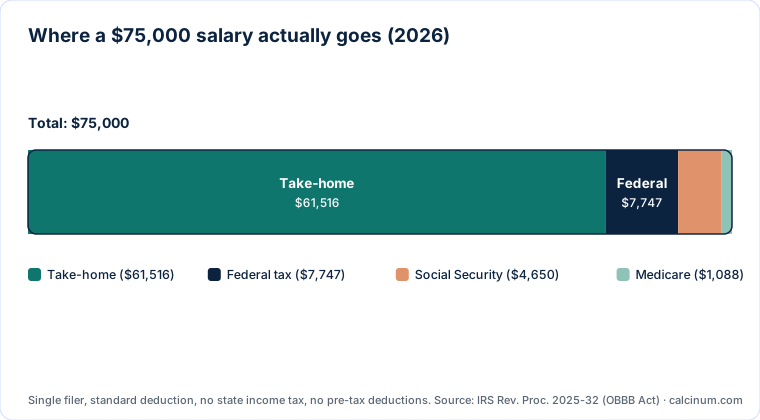
Where your money actually goes
On a typical pay stub, your gross pay is reduced by:
| Deduction | Typical size |
|---|---|
| Federal income tax | Varies by income and W-4 |
| State income tax | 0% to ~13% depending on state |
| Social Security | 6.2% (up to the $184,500 wage base in 2026) |
| Medicare | 1.45% (plus 0.9% over $200,000) |
| Health/dental/vision insurance | Pre-tax, varies |
| 401(k) / retirement | Whatever percent you elected |
Add those up and a 20% to 30% gap between gross and net is completely normal.
The 8 most common reasons your paycheck is low
- FICA takes 7.65% off the top. Social Security (6.2%) plus Medicare (1.45%) is automatic and unavoidable on wages. That alone is most of the gap for low earners.
- Your W-4 is set to withhold extra. Claiming “0” allowances-equivalent, checking the multiple-jobs box, or entering extra withholding in Step 4(c) all shrink your paycheck (and grow your refund).
- You live in a high-tax state. State income tax ranges from 0% (Texas, Florida, and seven others) to over 13% (California). The same salary nets very differently by state.
- Pre-tax benefits. Health insurance, 401(k), HSA, and FSA contributions reduce your take-home pay now, but they lower your taxable income and build savings, so this “loss” is really money working for you.
- It is your first paycheck. New jobs often prorate the first check for a partial pay period, so it looks unusually small.
- You got a bonus. Bonuses are withheld at a flat 22% federal supplemental rate (plus FICA and state), which often looks like a huge bite. You may get some back at tax time.
- You have more than one job. Each employer withholds as if it is your only income, which can under-withhold overall, but checking the Step 2 box on your W-4 to correct it makes each paycheck smaller.
- A raise pushed you into more withholding. Only the income above each bracket is taxed at the higher rate (that is your marginal rate), but withholding still rises, so a raise can feel smaller than expected.
”Why is my paycheck taxed so much?”
Two things to remember. First, the withholding on your paycheck is an estimate, not your final tax. If too much comes out, you get it back as a refund. Second, your marginal rate is not your real rate. You might be “in the 22% bracket,” but your effective rate (total tax divided by total income) is usually much lower, because the first chunks of income are taxed at 10% and 12%.
How to fix a paycheck that is too low
- Run the numbers. Use our take-home pay calculator to see exactly where each dollar goes for your salary and state.
- Adjust your W-4. If you consistently get a large refund, you are over-withholding, file a new W-4 with fewer adjustments to keep more each paycheck. Our W-4 calculator helps you dial it in.
- Review your benefit elections. Confirm your 401(k) and insurance choices are what you intended.
- Check the math on a raise with the salary calculator so the new take-home pay is no surprise.
Bottom line
A paycheck that is 20% to 30% smaller than your salary is normal, taxes and FICA explain most of it. If yours is lower, look at your W-4 settings, state, and pre-tax deductions first. And remember that withholding is just a prepayment; the calculator above shows your true take-home pay. This article is general information, not tax advice.
Related Calculators
Related articles

Rakesh Choudhary, PhD · Founder & Editor
Rakesh Choudhary, PhD, is the founder of Calcinum. A sociologist by training, he builds every calculator on the site and maintains its 2026 federal and state tax data, sourced from primary references (IRS, SSA, state revenue departments, DFAS) and re-verified whenever the law changes. Tax data is sourced from primary references (IRS, state revenue departments, SSA, DFAS) and re-verified annually each tax year.
Editorial standards: Our tax and financial figures come from primary sources — the IRS, SSA, and state revenue departments — and are reviewed against the current tax year before publication. See our full methodology & accuracy for our sourcing and review process.
Not financial advice: This article is for general informational purposes only. Calcinum does not provide regulated tax, legal, or investment advice. Consult a qualified professional for decisions specific to your situation.