What Is FICA? Social Security & Medicare Explained
FICA stands for the Federal Insurance Contributions Act, the federal payroll tax that funds Social Security and Medicare. It’s the line on your paycheck that combines two separate taxes: Social Security (6.2%) and Medicare (1.45%), totaling 7.65% of your wages. Your employer matches this with another 7.65%, so the total going to Social Security and Medicare is 15.3%. (Source: IRS Topic 751)
If you’re self-employed, you pay BOTH halves yourself, the full 15.3% as “self-employment tax.”
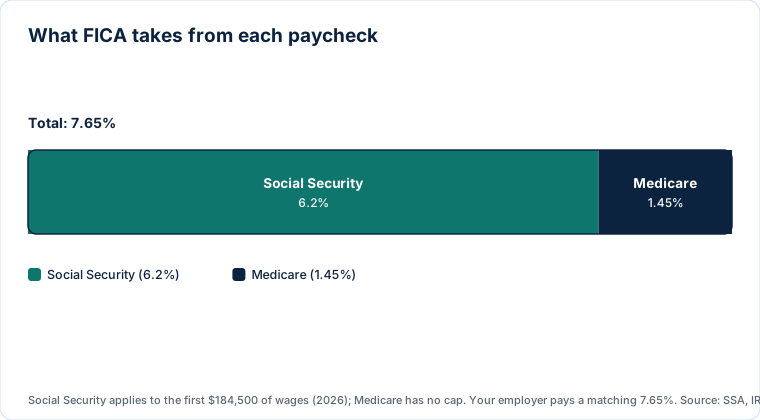
2026 FICA breakdown
Social Security tax (OASDI)
- Employee rate: 6.2%
- Wage base limit: $184,500 (2026), income above this isn’t subject to Social Security tax
- Employer rate: 6.2% (employer pays this on top of your wages)
- Total: 12.4% (employee + employer)
Medicare tax
- Employee rate: 1.45%
- Wage base limit: NONE, applies to all wages
- Employer rate: 1.45%
- Total: 2.9%
Additional Medicare tax (high earners)
- Employee rate: 0.9% on income above $200,000 single / $250,000 married
- Employer rate: 0% (NOT matched, only employees pay this)
- Wage base: Above the thresholds, no upper limit
Combined FICA on your paycheck
- Standard worker: 7.65% (6.2% + 1.45%) of wages
- High earner (over $200K): 8.55% (above the $200K threshold)
- Beyond the SS wage base ($184,500): drops to 1.45% (only Medicare)
How FICA appears on your paycheck
Look for these line items on your pay stub:
- Fed OASDI / EE or Social Security: 6.2% of gross wages
- Fed MED / EE or Medicare: 1.45% of gross wages
- Add’l Medicare: 0.9% (only if income over $200K)
Together they form your “FICA withholding.” Note this is in ADDITION to federal income tax, which is separately calculated based on your W-4 and income brackets.
How much FICA do I pay?
For typical earnings:
| Annual gross | Monthly FICA | Annual FICA |
|---|---|---|
| $30,000 | $191 | $2,295 |
| $50,000 | $319 | $3,825 |
| $75,000 | $478 | $5,738 |
| $100,000 | $638 | $7,650 |
| $150,000 | $956 | $11,475 |
| $200,000 | $1,195 | $14,339 |
| $250,000 | $1,293 | $15,514 (cap on SS hits) |
After Social Security wage base ($184,500), only Medicare (1.45% + 0.9% extra) continues.
Self-employment FICA (SE Tax)
Self-employed people pay the FULL FICA rate themselves:
- Social Security: 12.4% on net SE income up to $184,500
- Medicare: 2.9% on all net SE income
- Additional Medicare: 0.9% above $200K/$250K
- Total base rate: 15.3% on net earnings
This is called self-employment tax (Schedule SE).
Half deductible: You can deduct 50% of your self-employment tax as an above-the-line deduction (reduces AGI). This roughly equals what an employer would have paid, so the net economic effect is similar to W-2 workers.
What does FICA fund?
Social Security (6.2% / 12.4% total)
- Retirement benefits (62+, full benefits 67+)
- Disability benefits (SSDI for workers who can’t work)
- Survivors benefits (paid to family of deceased workers)
- Currently funds about $1.4 trillion/year in benefits
Medicare (1.45% / 2.9% total)
- Part A (hospital insurance), funded by Medicare tax
- Part B (doctors), Part D (drugs), partially funded by general revenue + premiums
- Currently funds about $900 billion/year in benefits
The “trust funds” for both are projected to face shortfalls in the 2030s-2040s without changes to revenue or benefits.
Does FICA reduce my refund or tax bill?
No. FICA is a SEPARATE tax from federal income tax. Adjusting your W-4 changes income tax withholding, but FICA remains fixed at 7.65% of your wages.
FICA cannot be refunded (with rare exceptions for excess SS tax if you have multiple jobs and your combined SS withholding exceeds the maximum).
How to verify your FICA is correct
- Check your pay stub: Social Security line should be 6.2% of gross wages. Medicare line should be 1.45%.
- Check year-end W-2: Box 4 (Social Security tax) should be 6.2% of Box 3 (SS wages). Box 6 (Medicare tax) should be 1.45% of Box 5 (Medicare wages).
- Year-end Social Security statement: Available at ssa.gov/myaccount, shows all earnings ever credited.
Errors are rare but happen, sometimes employers misclassify or use wrong rates. Worth verifying once a year.
FICA refund situations (rare)
You can get a refund of EXCESS Social Security tax if:
- You had multiple jobs and combined SS withholding exceeded the annual maximum ($11,439 in 2026)
- File Form 1040, Line 31 to claim the credit
- Medicare has no refund situation (no cap)
Can I opt out of FICA?
Generally NO. Some narrow exceptions:
- Certain religious groups (Amish, Mennonite) can opt out of Social Security (lose all future benefits)
- Some state/local government workers are exempt if covered by alternate pension
- Foreign students on F-1/J-1 visas in their first 5 years are exempt from FICA
- Self-employed earning under $400/year owe no SE tax
For everyone else, FICA is mandatory.
FICA FAQ
Q: Why is FICA so high on my paycheck? A: 7.65% feels significant. Combined with federal income tax (10-37%) and state tax (0-13%), your total withholding can easily be 25-40% of gross. This is why net pay feels much smaller than gross salary.
Q: Does FICA apply to bonuses? A: Yes. Bonuses are taxed as supplemental wages for federal income tax (22% flat OR aggregate method), but FICA is the same 7.65% as regular wages.
Q: Does FICA apply to 401(k) contributions? A: 401(k) contributions are excluded from federal AND state income tax in the year of contribution. BUT they are still subject to FICA. So FICA is calculated on your GROSS wages before 401(k).
Q: Do I owe FICA on tips? A: Yes. Reported tips are subject to FICA tax. Employers must collect FICA on reported tips through payroll. Unreported tips technically still owe FICA, paid by the worker via Form 4137.
Q: What about Roth 401(k) contributions and FICA? A: Same as traditional 401(k), FICA is calculated on gross wages before any 401(k) contributions. So Roth 401(k) doesn’t help reduce FICA (only federal income tax in the year of distribution).
Related calculators
- Take-Home Pay Calculator, Including FICA
- Self-Employment Tax Calculator, Full 15.3%
- Salary Calculator, Gross to net
- Tax Calculator, Federal income tax
- Take-Home Pay (Texas), State-specific examples
FICA is one of the most consistent and universal taxes, almost every working American pays it. Knowing exactly what it funds and how it’s calculated helps you make sense of your paycheck.
Related Calculators
Related articles

Rakesh Choudhary, PhD · Founder & Editor
Rakesh Choudhary, PhD, is the founder of Calcinum. A sociologist by training, he builds every calculator on the site and maintains its 2026 federal and state tax data, sourced from primary references (IRS, SSA, state revenue departments, DFAS) and re-verified whenever the law changes. Tax data is sourced from primary references (IRS, state revenue departments, SSA, DFAS) and re-verified annually each tax year.
Editorial standards: Our tax and financial figures come from primary sources — the IRS, SSA, and state revenue departments — and are reviewed against the current tax year before publication. See our full methodology & accuracy for our sourcing and review process.
Not financial advice: This article is for general informational purposes only. Calcinum does not provide regulated tax, legal, or investment advice. Consult a qualified professional for decisions specific to your situation.