What Is Compound Interest? (2026)
Compound interest is interest you earn on both your original money and the interest it has already earned. In other words, your interest earns interest. That small idea is the single most powerful force in personal finance, it makes savings and investments snowball over time, and it makes credit card debt spiral if you let it. (Source: SEC investor.gov)
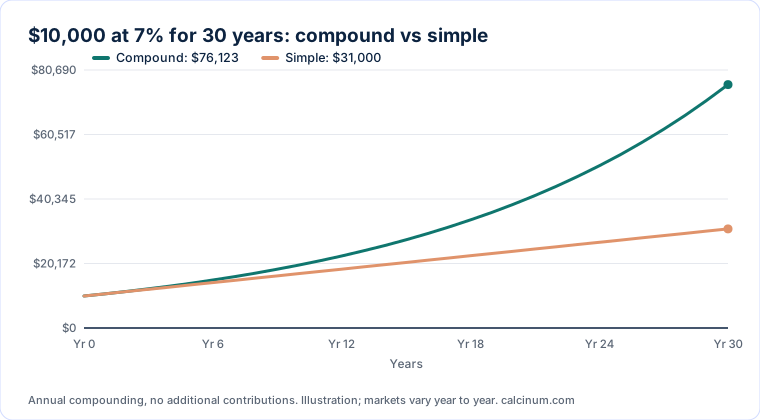
Simple vs. compound interest
- Simple interest is calculated only on your original amount (the principal). $1,000 at 5% simple interest earns $50 every year, forever.
- Compound interest is calculated on the principal plus accumulated interest. Year 1 earns $50 (on $1,000); year 2 earns $52.50 (on $1,050); and the gap widens every year.
Over a few years the difference is small. Over decades it is enormous.
The formula
A = P × (1 + r/n)nt
- A = final amount
- P = principal (starting amount)
- r = annual interest rate (as a decimal)
- n = times interest compounds per year
- t = number of years
The more frequently interest compounds (daily vs. monthly vs. yearly), the faster it grows.
The power of time
Compounding rewards patience. A one-time $1,000 invested at 8% becomes:
| Years | Value |
|---|---|
| 10 | ~$2,159 |
| 20 | ~$4,661 |
| 30 | ~$10,063 |
| 40 | ~$21,725 |
The money more than 20x’s in 40 years, and most of that growth happens in the final stretch, which is why starting early matters so much.
The Rule of 72
A quick shortcut: divide 72 by your interest rate to estimate how many years it takes your money to double. At 8%, that is 72 ÷ 8 = 9 years to double. At 6%, about 12 years.
It cuts both ways
Compound interest is your best friend when you are saving and investing, but your worst enemy when you owe. Credit cards often compound interest daily at 20%+ APR, so an unpaid balance grows alarmingly fast. The same force that builds wealth in a 401(k) digs a deeper hole on a credit card.
Bottom line
- Compound interest = interest on your interest, growing faster the longer it runs.
- Start early, time is the biggest lever, far more than the amount.
- It works for you when investing and against you when carrying high-interest debt.
See compounding in action with our interest calculator, and how it builds retirement wealth in the 401(k) calculator. This article is general information, not financial advice.
Related Calculators
Related articles

Rakesh Choudhary, PhD · Founder & Editor
Rakesh Choudhary, PhD, is the founder of Calcinum. A sociologist by training, he builds every calculator on the site and maintains its 2026 federal and state tax data, sourced from primary references (IRS, SSA, state revenue departments, DFAS) and re-verified whenever the law changes. Tax data is sourced from primary references (IRS, state revenue departments, SSA, DFAS) and re-verified annually each tax year.
Editorial standards: Our tax and financial figures come from primary sources — the IRS, SSA, and state revenue departments — and are reviewed against the current tax year before publication. See our full methodology & accuracy for our sourcing and review process.
Not financial advice: This article is for general informational purposes only. Calcinum does not provide regulated tax, legal, or investment advice. Consult a qualified professional for decisions specific to your situation.