How Much House Can I Afford in 2026? Rules & Calculator
“How much house can I afford?” is the first real question on every home-buying journey, and the answer matters more than almost any financial decision you’ll make in your life. Over-buying the house means 20+ years of feeling stretched, skipping vacations, and under-saving for retirement. Under-buying usually just means you paid a bit more in rent than you needed to. The asymmetry cuts hard in one direction. (Source: CFPB mortgage loan options)
This guide walks through the three rules of thumb lenders and financial advisors actually use, how 2026 mortgage rates translate income into purchase price, and the hidden costs that determine whether you can comfortably afford what you’re approved for.
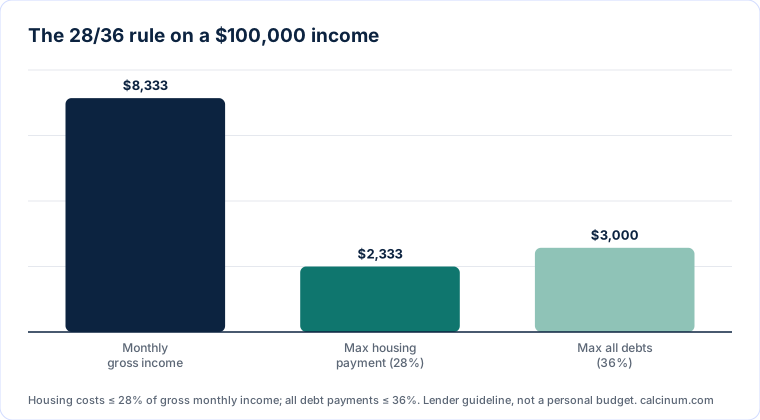
The 3 Rules of Affordability
Every home-affordability conversation comes back to these three numbers:
1. The 28% Rule (front-end DTI). Your monthly housing costs, principal, interest, taxes, insurance, PMI, HOA, should stay under 28% of your gross monthly income. Gross means pre-tax.
2. The 36% Rule (back-end DTI). Your total monthly debt payments, housing + car loans + student loans + credit card minimums + any other debt, should stay under 36% of gross monthly income. Some lenders stretch to 43% or even 50%, but 36% is the comfort zone.
3. The 3×–5× Income Rule. Your home purchase price should generally land between 3× and 5× your annual gross income, depending on debt load, down payment, and cost of living.
At a $75,000 gross annual income ($6,250/month), the three rules give:
| Rule | Limit |
|---|---|
| 28% housing | $1,750/month max mortgage + taxes + insurance |
| 36% total debt | $2,250/month all debts combined |
| 3×–5× income | Home price of $225K–$375K |
See your actual monthly payment for any price point with our Mortgage Calculator.
How Lenders Decide What You Can Afford
Lenders don’t care about what you should spend, they care about what you can repay. They look at two ratios:
- Front-end DTI = proposed housing payment ÷ gross monthly income. Conventional mortgages typically want this under 28%, though up to 36% is often allowed with strong credit.
- Back-end DTI = all monthly debt obligations ÷ gross monthly income. Conventional: 36–43% maximum. FHA: up to 43% (and 50% with compensating factors). VA: up to 41% is typical.
Credit score changes everything. A 760+ FICO might get 6.3% on a conventional 30-year fixed in 2026. A 650 FICO might get 7.25% on the same loan. On a $350,000 loan, that’s roughly $220/month more, which translates to about $50K less house you can afford at the same payment.
Home Affordability by Income (2026 Rates)
Approximate purchase prices at the 28% housing rule, assuming 20% down, ~6.5% rate, 30-year fixed, typical property tax and insurance:
| Gross Income | 28% Max Payment | Approx Home Price |
|---|---|---|
| $50,000 | $1,167/month | ~$200,000 |
| $60,000 | $1,400/month | ~$250,000 |
| $75,000 | $1,750/month | ~$310,000 |
| $100,000 | $2,333/month | ~$425,000 |
| $125,000 | $2,917/month | ~$530,000 |
| $150,000 | $3,500/month | ~$640,000 |
| $200,000 | $4,667/month | ~$870,000 |
| $250,000 | $5,833/month | ~$1.1M |
These assume no existing debt. Every $400/month of car or student loan payments reduces the affordable home price by roughly $60,000 at 2026 rates. Run your exact scenario, including taxes, insurance, and PMI, with our Mortgage Calculator.
Down Payment Impact
The size of your down payment changes everything: monthly payment, whether you pay PMI, and how much total house you can afford.
Comparing $350,000 home options:
| Down Payment | Cash Out of Pocket | Loan Amount | PMI | Approx Monthly P&I + PMI |
|---|---|---|---|---|
| 20% ($70,000) | $70,000 | $280,000 | None | $1,770 |
| 10% ($35,000) | $35,000 | $315,000 | ~$130/mo | $1,990 + $130 = $2,120 |
| 5% ($17,500) | $17,500 | $332,500 | ~$165/mo | $2,100 + $165 = $2,265 |
| 3.5% FHA ($12,250) | $12,250 | $337,750 | ~$235/mo + upfront | $2,135 + $235 = $2,370 |
Going from 20% down to 3.5% down costs roughly $600/month more on the same house, but lets you buy 5–7 years sooner than saving up for a full 20% down payment. The right answer depends on how fast your local market is appreciating and your personal cash-flow situation.
Hidden Costs Beyond the Mortgage
The monthly payment in your mortgage calculator isn’t the real monthly cost of owning a home. Budget for all of this:
Property tax, varies dramatically by state. New Jersey owners pay about 2.0–2.5% of home value annually and Texas around 1.6%. Hawaii and Alabama pay closer to 0.3–0.4%. On a $350,000 home, that’s the difference between $90/month (Hawaii) and $730/month (NJ). Estimate yours with our Property Tax Calculator.
Homeowner’s insurance, typically $1,500–$3,000/year, depending on state, home age, and coverage. Coastal states (FL, LA, SC) are pricier; Midwest and Mountain states are cheaper.
Private Mortgage Insurance (PMI), 0.5–1.0% of the loan amount annually, if you put less than 20% down. Removed automatically when you reach 78% loan-to-value on conventional loans.
HOA fees, $0–$800/month depending on community. A $300/month HOA reduces your affordable home price by roughly $45,000 at a fixed DTI.
Maintenance, budget 1% of home value per year as a long-term average. A $350K home: $3,500/year for paint, small repairs, HVAC service, appliances, roof over time. Some years you’ll spend nothing; some years you’ll replace a furnace.
Utilities, typically $200–$400/month for a 2,000 sq ft home, varying by climate and energy costs. Estimate utility costs, starting with electricity, using our Electricity Calculator.
Total monthly cost on a $350,000 home is typically $2,200–$3,200, noticeably more than the mortgage calculator’s raw principal-and-interest payment of $1,770.
How to Afford More House
Four levers actually work:
Increase your down payment. More cash down means a smaller loan and (at 20%+) no PMI. Saving an extra $15K before you buy often saves $200+/month once you do.
Improve your credit score. Moving from a 680 to a 760 FICO usually saves 0.5–0.75% on your mortgage rate, on a $350K loan, that’s $115–$170/month for 30 years. The biggest credit-score levers: pay on time, pay off credit card balances below 30% of limits, and avoid opening new accounts in the 6 months before applying.
Pay off other debts first. A $500/month car payment is eating $90,000 of affordable home price. Pay off the car before shopping for a mortgage and you get that affordability back.
Buy in a lower-cost area. A remote-work household with flexibility can buy 2× the house by moving from a top-10-expensive metro to a top-50. Compare real cost differences with our Cost of Living Calculator.
15-Year vs 30-Year Mortgage
The 15-year mortgage isn’t about affording less, it’s about affording differently. Typical 2026 rates:
- 30-year fixed: ~6.5%
- 15-year fixed: ~5.7%
On a $350,000 loan:
| Term | Rate | Monthly P&I | Total Interest Paid |
|---|---|---|---|
| 30-year | 6.5% | $2,212 | $446,000 |
| 15-year | 5.7% | $2,900 | $172,000 |
The 15-year costs $688 more per month but saves $274,000 in interest and pays off the house in half the time. Most borrowers don’t qualify for 15-year affordability at the same price point, they have to buy a smaller house to make it work. Worth doing the math if you’re choosing between a “nicer 30-year house” and a “smaller 15-year house.”
What You Can Afford vs What You Should Spend
Lenders will approve you for significantly more than is comfortable. Their models assume continued employment, no kids, no career changes, no major expenses. Your actual life doesn’t match those assumptions.
A better practical rule: 25% of take-home pay on housing, not 28% of gross.
For someone earning $75,000/year:
- 28% of gross = $1,750/month (lender’s max)
- 25% of take-home (~$58K net) = $1,210/month (comfortable)
The difference, $540/month, is the room for retirement savings, emergencies, vacations, and the next car. People who buy the lender-max house are the ones who feel “house poor” five years in.
Calculate your gross vs net income with our Salary Calculator and your actual take-home pay after taxes with our Take Home Pay Calculator.
The Emergency Fund Question
Before committing to a mortgage, have:
- 3–6 months of full monthly expenses in cash, not in stocks, not earmarked for down payment, not spent
- Enough cash buffer after closing to cover closing costs (2–5% of purchase price) plus immediate move-in needs (appliances, curtains, that one repair the inspector flagged)
A common mistake: draining savings to maximize down payment, then feeling vulnerable to any small surprise. A slightly smaller down payment with a solid emergency fund is usually the better trade.
A Reasonable Pre-Purchase Checklist
Before you start shopping:
- Know your credit score (all 3 bureaus) and fix any obvious errors
- Calculate your actual monthly take-home pay (not gross)
- Sum your current monthly debt obligations
- Run the 25%-of-take-home number as your ceiling
- Estimate property tax for your target market
- Get pre-approved (not pre-qualified) by 2–3 lenders to compare rates
- Have 6 months of expenses in cash, separate from your down payment
The households that are happiest 5 years into homeownership are almost always the ones who bought slightly less than they were approved for.
Find your comfortable price range. Use our free Mortgage Calculator to see real monthly payments with taxes, insurance, and PMI included, then cross-check against your actual Take Home Pay to be sure the number fits your life, not just your approval letter.
Related Calculators
Related articles

Rakesh Choudhary, PhD · Founder & Editor
Rakesh Choudhary, PhD, is the founder of Calcinum. A sociologist by training, he builds every calculator on the site and maintains its 2026 federal and state tax data, sourced from primary references (IRS, SSA, state revenue departments, DFAS) and re-verified whenever the law changes. Tax data is sourced from primary references (IRS, state revenue departments, SSA, DFAS) and re-verified annually each tax year.
Editorial standards: Our tax and financial figures come from primary sources — the IRS, SSA, and state revenue departments — and are reviewed against the current tax year before publication. See our full methodology & accuracy for our sourcing and review process.
Not financial advice: This article is for general informational purposes only. Calcinum does not provide regulated tax, legal, or investment advice. Consult a qualified professional for decisions specific to your situation.