2026 Federal Tax Brackets by Filing Status
The U.S. federal income tax system uses seven marginal tax brackets ranging from 10% to 37%. The rates have been the same since 2018, but the income thresholds get adjusted upward each year for inflation. The 2026 numbers reflect both the standard annual inflation adjustment and the One Big Beautiful Bill Act (OBBBA) signed in July 2025, which made the TCJA-era rates permanent (they were set to expire after 2025) and bumped up the standard deduction.
This guide lays out every 2026 bracket for every filing status, shows exactly how marginal rates work (one of the most-misunderstood concepts in taxes), and walks through practical examples of calculating your actual tax owed.
2026 Federal Tax Brackets at a Glance
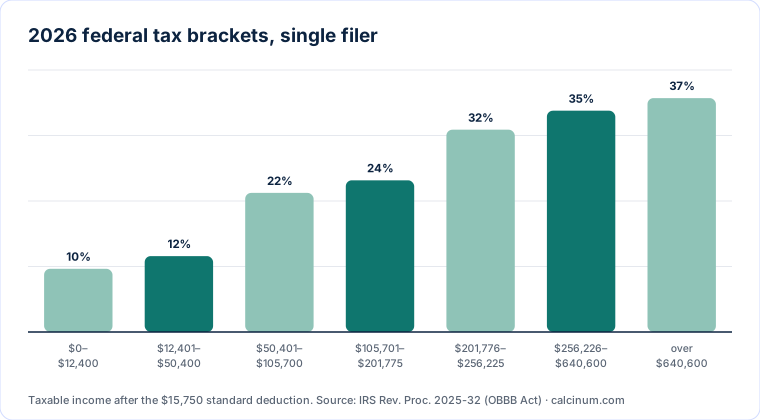
Seven rates, unchanged: 10%, 12%, 22%, 24%, 32%, 35%, 37%.
What changed in 2026:
- Every bracket threshold increased roughly 2.7% for inflation.
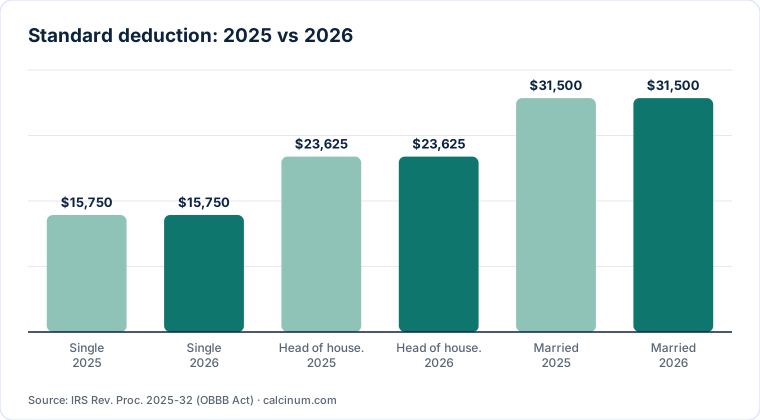
- Standard deduction increased (Source: IRS Pub. 17): single $15,750 → $16,100, married jointly $31,500 → $32,200, head of household $23,625 → $24,150.
- Social Security wage base increased $176,100 → $184,500 (affects FICA, not income tax).
- TCJA rates were made permanent, no longer set to expire.
- A new senior deduction was added: an extra $6,000 for taxpayers 65+, phasing out starting at $75K single / $150K married.
See which bracket you fall in with our Tax Bracket Calculator.
2026 Tax Brackets, Single Filers
| Rate | Taxable Income | Tax at Top of Bracket |
|---|---|---|
| 10% | $0 – $12,400 | $1,240 |
| 12% | $12,401 – $50,400 | $5,800 |
| 22% | $50,401 – $105,700 | $17,966 |
| 24% | $105,701 – $201,775 | $40,984 |
| 32% | $201,776 – $256,225 | $58,408 |
| 35% | $256,226 – $640,600 | $192,939 |
| 37% | $640,601+ | — |
A single filer with $75,000 taxable income is in the 22% bracket. Only the income above $50,400 is taxed at 22%, the rest is taxed at 10% and 12%.
2026 Tax Brackets, Married Filing Jointly
| Rate | Taxable Income | Tax at Top of Bracket |
|---|---|---|
| 10% | $0 – $24,800 | $2,480 |
| 12% | $24,801 – $100,800 | $11,600 |
| 22% | $100,801 – $211,400 | $35,932 |
| 24% | $211,401 – $403,550 | $81,948 |
| 32% | $403,551 – $512,450 | $116,816 |
| 35% | $512,451 – $768,700 | $206,503 |
| 37% | $768,701+ | — |
Married brackets are roughly 2× the single brackets through the 32% tier, then compress slightly in the top two brackets. This compression is what creates the “marriage penalty” for high-earning dual-income couples, if both spouses each earn $250K, they pay a bit more as a couple than two single filers would on the same combined income.
2026 Tax Brackets, Head of Household
| Rate | Taxable Income | Tax at Top of Bracket |
|---|---|---|
| 10% | $0 – $17,700 | $1,770 |
| 12% | $17,701 – $67,450 | $7,740 |
| 22% | $67,451 – $105,700 | $16,155 |
| 24% | $105,701 – $201,750 | $39,207 |
| 32% | $201,751 – $256,200 | $56,631 |
| 35% | $256,201 – $640,600 | $191,171 |
| 37% | $640,601+ | — |
Head of household is a meaningful tax advantage. A $75,000 earner saves roughly $1,400 in federal tax by filing HoH vs single, wider brackets and a bigger standard deduction ($24,150 vs $16,100). To qualify, you must be unmarried and pay more than half the cost of maintaining a home for a qualifying dependent.
2026 Tax Brackets, Married Filing Separately
| Rate | Taxable Income |
|---|---|
| 10% | $0 – $12,400 |
| 12% | $12,401 – $50,400 |
| 22% | $50,401 – $105,700 |
| 24% | $105,701 – $201,775 |
| 32% | $201,776 – $256,225 |
| 35% | $256,226 – $384,350 |
| 37% | $384,351+ |
Identical to single through the 32% tier, then the top brackets are slightly narrower. MFS is usually only beneficial in specific situations (student loan income-based repayment, one spouse has large medical deductions, liability separation).
How Marginal Tax Rates Actually Work
This is the single most-misunderstood part of U.S. taxes. Many people believe that if they cross into a higher bracket, their entire income is suddenly taxed at the higher rate, so a raise that pushes them from the 22% bracket into the 24% bracket must hurt them.
That’s not how it works. Only the income in each bracket is taxed at that bracket’s rate.
Worked Example: Single Filer, $85,000 Taxable Income
Apply the brackets one by one:
| Income in Bracket | Rate | Tax on Bracket |
|---|---|---|
| First $12,400 | 10% | $1,240 |
| Next $37,999 ($12,401 – $50,400) | 12% | $4,560 |
| Next $34,599 ($50,401 – $85,000) | 22% | $7,612 |
| Total federal income tax | $13,412 |
Effective tax rate: $13,412 ÷ $85,000 = 15.8%, not 22%.
That’s the critical distinction: a filer’s marginal rate (the bracket the next dollar hits) is always higher than their effective rate (total tax ÷ total income). A “22% bracket” taxpayer is actually paying closer to 16% of their taxable income in federal tax.
Raises never lose money in marginal-bracket taxation. A raise from $79K to $82K that pushes you “into the 22% bracket” gets taxed at 22%, but only the $3,000 of extra income, not your whole salary. Take-home pay always goes up with a raise.
Calculate your exact tax, including deductions, credits, and FICA, with our Tax Calculator.
2026 Standard Deduction
The standard deduction reduces your taxable income before the brackets apply. You choose between the standard deduction or itemizing (mortgage interest, SALT, charitable donations, medical costs). Most filers take the standard deduction, it’s larger than their itemizable amount after the TCJA nearly doubled it.
| Filing Status | 2026 Standard Deduction |
|---|---|
| Single | $16,100 |
| Married filing jointly | $32,200 |
| Head of household | $24,150 |
| Married filing separately | $16,100 |
Additional amounts for age 65+ or blind:
- Unmarried: +$2,050 per condition
- Married: +$1,650 per condition, per spouse
New for 2026, Senior Deduction. The OBBBA added a $6,000 deduction for age 65+, which phases out above $75,000 AGI (single) / $150,000 AGI (married). This is on top of the age-65 standard deduction add-on. For qualifying seniors, it can meaningfully reduce taxable income.
Example: How the Standard Deduction Works
A single filer earning $85,000 in wages (not taxable income yet) claims the standard deduction:
- Gross income: $85,000
- Standard deduction: −$16,100
- Taxable income: $68,900
Apply the brackets to $68,900 (not $85,000):
| Bracket | Rate | Tax |
|---|---|---|
| First $12,400 | 10% | $1,240 |
| $12,401 – $50,400 | 12% | $4,560 |
| $50,401 – $68,900 ($18,499) | 22% | $4,070 |
| Total federal tax | $9,870 |
Effective rate on $85K gross: 11.6%, lower than the earlier example because we accounted for the standard deduction.
What Changed From 2025 to 2026
| Item | 2025 | 2026 | Change |
|---|---|---|---|
| Top single bracket starts at | $626,350 | $640,600 | +2.3% |
| 22% single bracket starts at | $48,475 | $50,400 | +4.0% |
| Standard deduction (single) | $15,750 | $16,100 | +2.2% |
| Standard deduction (married) | $31,500 | $32,200 | +2.2% |
| Standard deduction (HoH) | $23,625 | $24,150 | +2.2% |
| SS wage base | $176,100 | $184,500 | +4.8% |
Net effect for most households: taxes go down modestly at a fixed income. A single filer earning $75,000 in both years pays $279 less in federal income tax in 2026 than in 2025 ($7,670 against $7,949), purely due to bracket indexing and the larger standard deduction.
The bigger news of 2026 is what didn’t change: the OBBBA made the 10–37% rate structure permanent. Under the original TCJA, brackets were scheduled to revert to 2017 levels (10, 15, 25, 28, 33, 35, 39.6%) at the end of 2025. That didn’t happen, and there’s no current legislation bringing those rates back.
How to Lower Your Tax Bracket
You can’t move your ordinary income tax rate directly, but you can reduce the taxable income the brackets apply to.
Pre-tax 401(k) contributions, Every dollar contributed to a traditional 401(k) reduces your taxable income dollar-for-dollar. 2026 limit: $24,500 (under 50), or $32,500 (50+ with catch-up; $35,750 at ages 60–63). A married couple maxing out both 401(k)s removes $49,000 from taxable income, often enough to drop a full tax bracket. See how much a 401(k) contribution saves in taxes with our 401k Calculator.
HSA contributions, Triple tax-advantaged. 2026 limits: $4,400 (self-only) or $8,750 (family). Must be paired with an HSA-qualified high-deductible health plan.
Traditional IRA contributions, $7,500 limit in 2026 (under 50), $8,600 (50+). If you’re covered by a workplace plan, deductibility phases out between $81,000 and $91,000 of modified AGI (single) or $129,000 and $149,000 (married filing jointly).
Student loan interest deduction, Up to $2,500/year above-the-line. Phases out between $85,000 and $100,000 of modified AGI (single) / $175,000 and $205,000 (married filing jointly).
Charitable donations (itemizers only, except for new 2026 non-itemizer option), full deduction for cash gifts to 501(c)(3) organizations. New in 2026: $1,000 non-itemizer deduction for single filers, $2,000 married. Small change but applies to non-itemizers for the first time since 2021.
HSA + 401(k) example: A single filer earning $95,000 who maxes both accounts ($4,400 HSA + $24,500 401(k) = $28,900 pre-tax) cuts the income that can be taxed from $95,000 to $66,100. The $16,100 standard deduction brings taxable income to $50,000, just inside the 12% bracket (which ends at $50,400) instead of $78,900, deep in the 22% bracket. Federal income tax falls from $12,070 to $5,752: a saving of $6,318.
Plan your Roth IRA contributions with our Roth IRA Calculator for after-tax growth.
What’s Not Covered by These Brackets
These brackets apply to ordinary income, wages, self-employment, interest, short-term capital gains, and most retirement account withdrawals. Different rates apply to:
- Long-term capital gains (assets held >1 year): 0% / 15% / 20%, with thresholds tied to taxable income. Most earners sit at 15%.
- Qualified dividends: Same 0/15/20% structure as long-term capital gains.
- Social Security / Medicare (FICA): 7.65% employee share, 7.65% employer share, 15.3% for self-employed (up to the wage base).
- Net Investment Income Tax (NIIT): Extra 3.8% on investment income for AGI over $200K single / $250K married.
- Additional Medicare Tax: Extra 0.9% on wages over $200K single / $250K married.
The ordinary income brackets above are the backbone, but your actual federal tax bill is always some combination of these.
Find your exact 2026 tax bracket and effective rate. Our free Tax Bracket Calculator shows every bracket your income crosses and computes your marginal and effective rates side by side. For your full tax picture with deductions, credits, and FICA included, use the Tax Calculator.
Related Calculators
Related articles

Rakesh Choudhary, PhD · Founder & Editor
Rakesh Choudhary, PhD, is the founder of Calcinum. A sociologist by training, he builds every calculator on the site and maintains its 2026 federal and state tax data, sourced from primary references (IRS, SSA, state revenue departments, DFAS) and re-verified whenever the law changes. Tax data is sourced from primary references (IRS, state revenue departments, SSA, DFAS) and re-verified annually each tax year.
Editorial standards: Our tax and financial figures come from primary sources — the IRS, SSA, and state revenue departments — and are reviewed against the current tax year before publication. See our full methodology & accuracy for our sourcing and review process.
Not financial advice: This article is for general informational purposes only. Calcinum does not provide regulated tax, legal, or investment advice. Consult a qualified professional for decisions specific to your situation.