What States Have No Sales Tax? Complete 2026 Guide
What states have no sales tax? Five U.S. states charge no statewide sales tax: Oregon, Montana, New Hampshire, Delaware, and Alaska. But “no sales tax” doesn’t mean “no taxes”, each of these states makes up the revenue through other means. Here’s the full picture for 2026. (Source: IRS Publication 17)
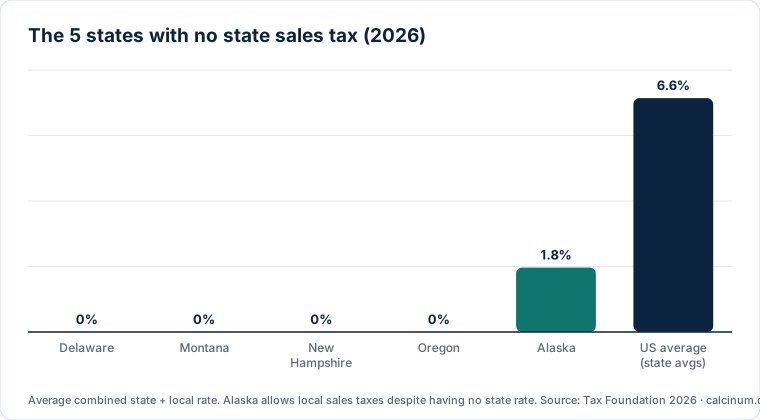
The 5 No Sales Tax States
Oregon
Oregon is the most well-known no sales tax state, and it’s absolute. There is no state sales tax and no local sales taxes anywhere in Oregon. This makes Portland a popular shopping destination for residents of neighboring Washington (which charges 6.5% state + local sales tax).
What Oregon charges instead:
- Income tax: 4.75% to 9.9% (one of the highest state income tax rates in the country)
- Corporate activity tax: 0.57% on commercial activity over $1 million
- Property tax: Moderate, with assessment growth capped at 3% per year (Measure 50)
Does Oregon have sales tax? No, not at the state or local level. Oregon’s constitution prohibits sales taxes, and voters have rejected sales tax ballot measures multiple times.
Montana
Does Montana have sales tax? No statewide sales tax. However, Montana allows a small number of “resort communities” (like Big Sky, Red Lodge, and West Yellowstone) to impose a local resort tax of up to 3% on luxury goods, accommodations, and restaurant meals. This isn’t technically a sales tax, but it functions similarly in those specific tourist areas.
What Montana charges instead:
- Income tax: 4.7% and 5.65% (2 brackets; the top rate drops to 5.4% in 2027)
- Property tax: Relatively high on residential property, with a complex assessment system using different tax rates for different property classes
- No local option sales taxes outside resort areas
New Hampshire
New Hampshire has no general sales tax, you won’t pay tax on clothing, electronics, groceries, or most purchases. However, it does charge a 9% Meals and Rooms Tax on restaurant meals, hotel stays, and car rentals. This is effectively a targeted sales tax on hospitality and tourism.
What New Hampshire charges instead:
- No income tax on wages (one of only 9 no-income-tax states)
- Interest & dividends tax: Was 5% but fully repealed as of January 1, 2025, New Hampshire now has zero income tax on all types of income
- Property tax: Among the highest in the nation (effective rate ~1.86%), which is how New Hampshire funds schools and local government without broad-based taxes
- Business profits tax: 7.5% on business income
Delaware
Delaware has no sales tax at all, no state sales tax and no local sales tax. Combined with no income tax on out-of-state shoppers, Delaware has become a magnet for retail shopping, particularly at the Christiana Mall and Tanger Outlets near the Pennsylvania border.
What Delaware charges instead:
- Income tax: 2.2% to 6.6% (graduated, 7 brackets)
- Gross receipts tax: Instead of a sales tax, Delaware charges businesses a gross receipts tax of 0.0945% to 1.9914% on total revenue (not profit). This cost is often partially embedded in prices, making Delaware prices slightly higher than they appear
- Corporate franchise tax: Delaware is the incorporation capital of the U.S., over 60% of Fortune 500 companies are incorporated there, generating substantial revenue from franchise fees
- Property tax: Low (effective rate ~0.55%)
Alaska
Alaska’s situation is unique. There is no statewide sales tax, but unlike the other four states, Alaska allows local governments to impose their own sales taxes. About 100 Alaska municipalities charge local sales tax, typically ranging from 1% to 7.5%. Juneau charges 5%, and some rural communities charge even more.
What Alaska charges instead:
- No income tax (one of 9 no-income-tax states)
- Permanent Fund Dividend (PFD): Alaska actually pays residents, the 2024 PFD was $1,702 per person (funded by oil revenue)
- Oil and gas revenue: Alaska funds most of its government through petroleum taxes and royalties
- Local sales taxes: Vary widely, from 0% in Anchorage to 7.5% in some rural boroughs
- Property tax: Moderate to high, varies significantly by municipality
Comparison Table
| State | Sales Tax | Income Tax | Property Tax (Effective) | Other Revenue Source |
|---|---|---|---|---|
| Oregon | None | 4.75–9.9% | 0.87% | Corporate activity tax |
| Montana | None* | 4.7–5.65% | 0.74% | Natural resources |
| New Hampshire | None** | None | 1.86% | Meals & rooms tax, business profits tax |
| Delaware | None | 2.2–6.6% | 0.55% | Gross receipts tax, corporate franchise fees |
| Alaska | None*** | None | 1.12% | Oil revenue, local sales taxes |
* Montana allows resort taxes in select tourist communities (up to 3%) ** New Hampshire charges 9% meals and rooms tax *** Alaska has no state sales tax but allows local sales taxes (0–7.5%)
States With the Lowest Sales Tax Rates
If you can’t live in a no-sales-tax state, these states have the lowest rates:
| State | State Rate | Avg. Local | Combined |
|---|---|---|---|
| Colorado | 2.9% | 4.87% | 7.77% |
| Alabama | 4% | 5.27% | 9.27% |
| Georgia | 4% | 3.38% | 7.38% |
| Hawaii | 4% | 0.50% | 4.50% |
| Wyoming | 4% | 1.44% | 5.44% |
| New York | 4% | 4.53% | 8.53% |
Note: Hawaii’s 4% rate is technically a General Excise Tax (GET), which is applied at each level of the supply chain and can effectively result in a higher rate for consumers. Colorado’s low state rate is offset by high local rates, giving it one of the highest combined rates in practice.
Use our sales tax calculator to calculate the exact tax on any purchase in any state, and our property tax calculator to see how property taxes compare across states.
Tax-Free Shopping: Online Purchases and Tourists
Online Shopping
Since the 2018 Supreme Court decision in South Dakota v. Wayfair, states can require out-of-state online retailers to collect sales tax based on where the buyer lives, not where the seller is located. This means living in a no-sales-tax state does give you a genuine advantage on online purchases: retailers are not required to collect sales tax on shipments to Oregon, Montana, New Hampshire, Delaware, or Alaska (though Alaska localities with local sales taxes may still apply).
Shopping Tourism
Residents of high-sales-tax states frequently cross borders to shop in no-sales-tax states:
- Washington residents shop in Portland, OR (saving 6.5–10.4% on large purchases)
- Pennsylvania and New Jersey residents shop in Delaware (saving 6–6.625%)
- Tourists in New Hampshire stock up on big-ticket items like furniture and electronics
Technically, most states require residents to self-report and pay use tax on out-of-state purchases, but compliance is minimal for personal purchases.
How No Sales Tax Affects Your Budget
No sales tax saves roughly $1,500–$3,000 per year for a typical household, depending on spending habits. But the savings can be offset by higher income or property taxes. Use our cost of living calculator to compare the full picture between cities, and our take home pay calculator to see how state income tax differences affect your actual paycheck.
For example, someone earning $75,000 in Portland, Oregon pays no sales tax but faces a 9% state income tax. The same person in Seattle, Washington pays no income tax but 10.4% sales tax on purchases. The net difference depends on how much you spend vs. how much you earn.
Frequently Asked Questions
Which states have no sales tax?
Five states have no statewide sales tax: Oregon, Montana, New Hampshire, Delaware, and Alaska. Oregon and Delaware have the cleanest “no sales tax” policies with no local exceptions. Montana and New Hampshire have narrow targeted taxes (resort tax and meals/rooms tax, respectively). Alaska has no state sales tax but allows local municipalities to levy their own.
Does Alaska really have no sales tax?
Alaska has no statewide sales tax, but it’s the only one of the five “no sales tax states” that allows local governments to impose sales taxes. About 100 municipalities in Alaska charge local sales tax, ranging from 1% to 7.5%. Anchorage, the largest city, has no local sales tax. Rural boroughs tend to have higher rates because they have fewer other revenue sources.
Is food taxed in no-sales-tax states?
In Oregon, Montana, Delaware, and Alaska (where no local tax applies), groceries are not taxed at all. In New Hampshire, groceries and most food items are exempt, but restaurant meals are subject to the 9% meals and rooms tax. Across all five states, unprepared grocery food purchased at a store is effectively untaxed.
Can I shop online tax-free from no-sales-tax states?
If you live in a no-sales-tax state, yes, online retailers generally don’t collect sales tax on orders shipped to your address. If you live in a state with sales tax and order from a retailer in a no-sales-tax state, you still owe your home state’s sales tax (the retailer collects it if they have nexus in your state, per the Wayfair ruling). The tax advantage applies to where the buyer is located, not the seller.
What is a gross receipts tax?
A gross receipts tax is a tax on a business’s total revenue (gross receipts), regardless of profitability. Unlike a sales tax (paid by the consumer at the point of sale), a gross receipts tax is paid by the business and often embedded in prices. Delaware uses this instead of a sales tax (0.0945%–1.9914% depending on business type). Ohio, Nevada, Oregon (corporate activity tax), Texas (margin tax), and Washington (B&O tax) also use forms of gross receipts taxes. Critics argue they create “tax pyramiding”, taxes on taxes at each stage of production.
Related Calculators
Related articles

Rakesh Choudhary, PhD · Founder & Editor
Rakesh Choudhary, PhD, is the founder of Calcinum. A sociologist by training, he builds every calculator on the site and maintains its 2026 federal and state tax data, sourced from primary references (IRS, SSA, state revenue departments, DFAS) and re-verified whenever the law changes. Tax data is sourced from primary references (IRS, state revenue departments, SSA, DFAS) and re-verified annually each tax year.
Editorial standards: Our tax and financial figures come from primary sources — the IRS, SSA, and state revenue departments — and are reviewed against the current tax year before publication. See our full methodology & accuracy for our sourcing and review process.
Not financial advice: This article is for general informational purposes only. Calcinum does not provide regulated tax, legal, or investment advice. Consult a qualified professional for decisions specific to your situation.