Is Overtime Taxed More? How Overtime Pay Is Really Taxed
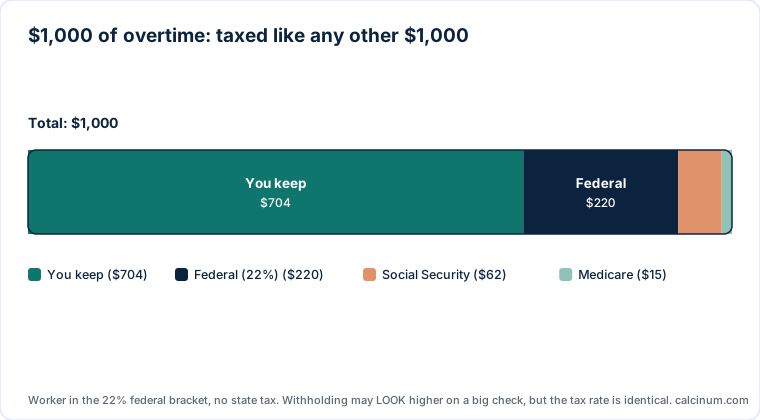
Is there tax on overtime? Yes, but it’s taxed at exactly the same income tax rates as your regular pay. There is no special “overtime tax rate” in the U.S. tax code. This is one of the most persistent tax myths, and it’s worth understanding why the myth exists and what’s actually happening with your paycheck.
The Myth: Overtime Is Taxed at a Higher Rate
Many workers look at a paycheck that includes overtime hours and see that the tax withholding seems disproportionately high compared to a regular paycheck. The take-home on those overtime hours appears to be much less than expected. The natural conclusion: “the government taxes overtime more.”
This is incorrect. There is no separate tax rate for overtime income. All of your income, regular pay, overtime pay, bonuses, commissions, is combined and taxed using the same federal income tax brackets.
How Overtime Pay Is Actually Taxed
When you file your annual tax return, the IRS looks at your total income for the year and applies the same progressive tax brackets to all of it. There is no line on Form 1040 for “overtime income”, it’s all just “wages, salaries, tips.”
So if overtime is not taxed differently, why does your overtime paycheck look like more tax was taken out? There are two reasons.
Reason 1: Withholding Annualization
Your employer’s payroll system uses a method called annualization to calculate withholding on each paycheck. Here’s how it works:
- The system takes your gross pay for this pay period
- Multiplies it by the number of pay periods in a year (26 for biweekly, 24 for semi-monthly)
- Applies tax brackets to that projected annual income
- Divides the annual tax by the number of periods to get this paycheck’s withholding
When you work overtime, your paycheck is larger than usual. The system multiplies that inflated paycheck by 26 (or 24) and projects a much higher annual income. This higher projected income lands in a higher tax bracket, causing more withholding on that specific check.
But you won’t actually earn that inflated amount every pay period. When you file your annual return, the IRS calculates your actual total income and applies the real brackets. Any excess withholding comes back to you as a refund.
Example: You normally earn $2,000/biweekly. The system projects $52,000/year and withholds accordingly. One pay period you earn $2,800 (including overtime). The system now projects $72,800/year, pushing projected income into a higher bracket, and withholds more for that check. But your actual annual income is still around $54,000 (not $72,800), so you’ll get the excess back at tax time.
Reason 2: Marginal Tax Brackets
Even setting aside the withholding mechanics, it is true that some overtime dollars may be taxed at a higher marginal rate than your regular pay, but this is simply how progressive taxation works for all income, not something unique to overtime.
If your regular salary puts you near the top of the 12% bracket, overtime income may push some earnings into the 22% bracket. However, only the dollars above the bracket threshold are taxed at 22%, not your entire income and not all of your overtime.
This is the same thing that happens when you get a raise, earn a bonus, or have any additional income. It’s not a penalty on overtime specifically.
Detailed Example: $50K Salary + $5K Overtime
Let’s walk through a concrete example. Single filer, 2026, earning $50,000 in regular salary plus $5,000 in overtime pay ($55,000 total gross):
Tax on Regular Salary Only ($50,000)
| Income Range | Rate | Tax |
|---|---|---|
| $0 – $16,100 (standard deduction) | 0% | $0 |
| $16,100 – $28,500 ($12,400 in 10% bracket) | 10% | $1,240 |
| $28,500 – $50,000 ($21,500 in 12% bracket) | 12% | $2,580 |
| Total federal tax | $3,820 | |
| Effective rate | 7.6% |
Tax on Total Income ($55,000, with $5K overtime)
| Income Range | Rate | Tax |
|---|---|---|
| $0 – $16,100 (standard deduction) | 0% | $0 |
| $16,100 – $28,500 | 10% | $1,240 |
| $28,500 – $55,000 ($26,500 in 12% bracket) | 12% | $3,180 |
| Total federal tax | $4,420 | |
| Effective rate | 8.0% |
The overtime added $600 in additional tax, taxed at the same 12% rate as most of the regular salary. The effective tax rate increased by only 0.4 percentage points. The overtime was not “punished”, it was taxed identically to regular income in the same bracket.
What About FICA?
Social Security tax (6.2%) and Medicare tax (1.45%) apply to overtime at the same flat rates as regular pay. These are not progressive, every dollar of wages up to $184,500 pays 6.2% Social Security, and every dollar pays 1.45% Medicare (plus an additional 0.9% above $200,000). Overtime doesn’t change these rates.
The “Supplemental Wage” Withholding Method
There’s one more wrinkle that contributes to the myth. The IRS allows employers to use a flat 22% withholding rate on “supplemental wages”, which can include overtime, bonuses, commissions, and severance pay (IRS Publication 15, Section 7). Some payroll systems apply this flat 22% to overtime pay specifically.
If your actual marginal rate is 12%, having 22% withheld on overtime makes the paycheck look like overtime is taxed almost twice as much. But again, this is a withholding issue, not a tax rate issue. You’ll get the 10% difference back as a refund when you file.
Not all employers use the supplemental wage method for overtime, many simply apply the annualized method described above. Either way, your actual annual tax obligation is the same.
What You Can Do About Over-Withholding
If your overtime paychecks are consistently over-withheld and you’d rather have the money now instead of waiting for a refund:
- Adjust your W-4: Add a small amount in Step 4(b) (“Deductions”) or reduce withholding through the IRS Withholding Estimator. Be careful not to adjust too much, or you’ll owe at tax time.
- Track your withholding mid-year: Compare your year-to-date withholding (on your pay stub) to your estimated annual tax liability. Use our tax bracket calculator to see exactly which bracket your overtime income falls in.
- Accept the refund: Many people prefer slightly over-withholding as forced savings. A $500–$1,000 refund costs you relatively little in lost interest but prevents an unexpected tax bill.
The “No Tax on Overtime” Deduction (2025-2028)
The One Big Beautiful Bill Act (OBBB) created a “No Tax on Overtime” provision that lets eligible workers deduct the premium part of their required overtime pay, the “half” of time-and-a-half, up to $12,500 a year ($25,000 on a joint return), from federal taxable income for tax years 2025 through 2028. This is a deduction on the federal income tax portion only, overtime is still subject to Social Security, Medicare, and (in most states) state income tax. See our Is There Tax on Overtime? guide for the full eligibility rules, phase-outs, and examples.
Bottom Line
Is overtime taxed differently? No. Overtime is taxed at the same federal income tax rates as regular pay. The reason your overtime paycheck looks more heavily taxed is because of withholding mechanics, your employer’s payroll system over-estimates your projected annual income when it sees a larger-than-normal paycheck. Any over-withholding is returned to you as a refund.
Use our salary calculator to see the real impact of overtime on your annual take-home pay, or our take home pay calculator to model different overtime scenarios across all 50 states.
Related Calculators
Related articles

Rakesh Choudhary, PhD · Founder & Editor
Rakesh Choudhary, PhD, is the founder of Calcinum. A sociologist by training, he builds every calculator on the site and maintains its 2026 federal and state tax data, sourced from primary references (IRS, SSA, state revenue departments, DFAS) and re-verified whenever the law changes. Tax data is sourced from primary references (IRS, state revenue departments, SSA, DFAS) and re-verified annually each tax year.
Editorial standards: Our tax and financial figures come from primary sources — the IRS, SSA, and state revenue departments — and are reviewed against the current tax year before publication. See our full methodology & accuracy for our sourcing and review process.
Not financial advice: This article is for general informational purposes only. Calcinum does not provide regulated tax, legal, or investment advice. Consult a qualified professional for decisions specific to your situation.