BMI Chart for Men and Women: What's a Healthy BMI in 2026?
BMI (Body Mass Index) is the number your doctor checks at most physicals. It’s a screening tool, not a diagnosis, that takes two inputs (height and weight) and gives a single number that flags potential weight-related health risks.
This guide gives you the complete BMI chart for men and women, explains what every category actually means, and is honest about the things BMI gets wrong (which matters more than most online BMI pages let on). The formula and categories are CDC’s (Adult BMI Categories, BMI FAQ), and every figure in the tables below is computed from them.
What Is BMI?
BMI = weight (kg) ÷ height (m)², or in U.S. units, weight (lbs) ÷ height (in)² × 703.
It’s a ratio of weight to height, full stop. It doesn’t measure body fat directly, doesn’t care about muscle versus fat, and doesn’t adjust for age, sex, or ethnicity. What it does do, cheaply, quickly, and reliably, is give a single number that CDC says is moderately to strongly associated with other measures of body fat, which is what makes it useful as a first screen.
Calculate your BMI instantly with our free BMI Calculator, it handles both metric and imperial units.
BMI Chart, Full Reference Table
The table below shows BMI at common height/weight intersections. Find your height on the left column, your weight across the top, and read the BMI at the intersection.
| Height | 100 lb | 120 lb | 140 lb | 160 lb | 180 lb | 200 lb | 220 lb | 240 lb | 280 lb |
|---|---|---|---|---|---|---|---|---|---|
| 4'10" | 20.9 | 25.1 | 29.3 | 33.4 | 37.6 | 41.8 | 46.0 | 50.2 | 58.5 |
| 5'0" | 19.5 | 23.4 | 27.3 | 31.2 | 35.2 | 39.1 | 43.0 | 46.9 | 54.7 |
| 5'2" | 18.3 | 21.9 | 25.6 | 29.3 | 32.9 | 36.6 | 40.2 | 43.9 | 51.2 |
| 5'4" | 17.2 | 20.6 | 24.0 | 27.5 | 30.9 | 34.3 | 37.8 | 41.2 | 48.1 |
| 5'6" | 16.1 | 19.4 | 22.6 | 25.8 | 29.0 | 32.3 | 35.5 | 38.7 | 45.2 |
| 5'8" | 15.2 | 18.2 | 21.3 | 24.3 | 27.4 | 30.4 | 33.4 | 36.5 | 42.6 |
| 5'10" | 14.3 | 17.2 | 20.1 | 23.0 | 25.8 | 28.7 | 31.6 | 34.4 | 40.2 |
| 6'0" | 13.6 | 16.3 | 19.0 | 21.7 | 24.4 | 27.1 | 29.8 | 32.5 | 38.0 |
| 6'2" | 12.8 | 15.4 | 18.0 | 20.5 | 23.1 | 25.7 | 28.2 | 30.8 | 35.9 |
| 6'4" | 12.2 | 14.6 | 17.0 | 19.5 | 21.9 | 24.3 | 26.8 | 29.2 | 34.1 |
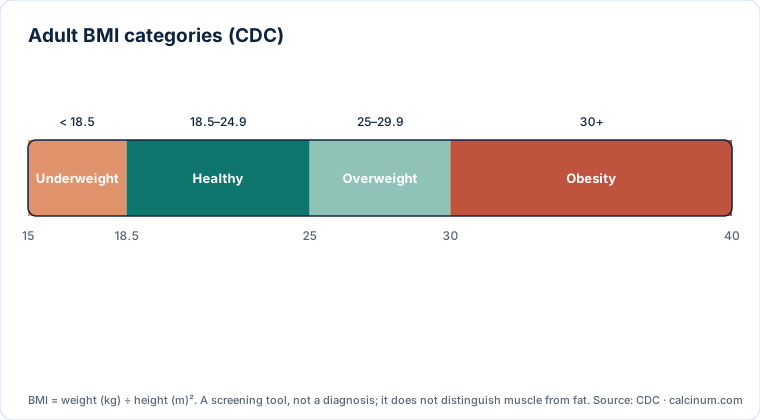
Ranges: underweight (below 18.5), healthy weight (18.5 to 24.9), overweight (25.0 to 29.9), obesity (30.0 or greater).
For a cleaner lookup with any height and weight combination, in any unit, use our BMI Calculator.
BMI Categories (CDC)
CDC uses these categories for adults 20 and older, splitting obesity into three classes:
| Category | BMI Range |
|---|---|
| Underweight | Below 18.5 |
| Healthy weight | 18.5 to 24.9 |
| Overweight | 25.0 to 29.9 |
| Class 1 obesity | 30.0 to 34.9 |
| Class 2 obesity | 35.0 to 39.9 |
| Class 3 obesity (severe) | 40.0 or greater |
These are the same categories for both men and women: CDC applies them regardless of age, sex, or race. You’ll occasionally see “BMI chart for women” and “BMI chart for men” as separate charts online, but they use identical values.
BMI for Men vs Women
The categories don’t differ by sex. What BMI can’t tell you is what the weight is made of. CDC notes that BMI cannot distinguish between fat, muscle, and bone, and that people with a lot of muscle can have a BMI in the overweight or even obesity range.
So two people with identical BMIs, whether two men, two women, or one of each, can have very different body-fat percentages. That’s why BMI is only the first step.
For a more accurate picture of your body composition, our Body Fat Calculator uses the U.S. Navy circumference method, which accounts for waist, neck, and (for women) hip measurements.
Limitations of BMI, The Honest Version
BMI’s main weaknesses are well-documented:
- It doesn’t distinguish muscle from fat. A 6’0”, 225 lb NFL running back has a BMI of 30.5, technically in the obesity range. No reasonable person looking at him would agree.
- It doesn’t account for where fat is stored. CDC says BMI cannot indicate where fat is located in the body, and a large waist is tied to heart disease and type 2 diabetes (see waist size below).
- It uses one set of cut-offs for every adult. CDC applies the same categories from age 20 regardless of age, sex, or race. Some guidance departs from that: NIDDK’s list of risk factors for diabetes screening counts a BMI of 23 or more as overweight for Asian Americans, against 25 for other adults.
- It’s a screening tool, not a diagnosis. Doctors use BMI as a first look, not as the final answer.
One additional measurement adds a lot: waist circumference. The National Heart, Lung, and Blood Institute says a waist of more than 40 inches (men) or 35 inches (women) increases the risk of heart disease and type 2 diabetes.
See your ideal weight range based on height and frame size with our Ideal Weight Calculator, it uses four different medical formulas (Devine, Robinson, Miller, Hamwi) so you can see the range rather than a single number.
What Your BMI Means for Your Health
Here is what each range means, and what CDC says about the health risks that come with obesity:
Underweight (BMI below 18.5), below the range CDC calls healthy weight. A low BMI, especially after weight loss you didn’t intend, is worth raising with a doctor.
Healthy weight (18.5 to 24.9), the range CDC calls healthy weight.
Overweight (25.0 to 29.9), above the healthy range. It’s a prompt to look at the measures BMI misses, such as waist size, blood pressure, blood sugar, and cholesterol, rather than a verdict on its own.
Obesity (30+), CDC’s list of consequences of obesity includes higher risk of high blood pressure, high cholesterol, type 2 diabetes, heart disease and stroke, many types of cancer, breathing problems such as asthma and obstructive sleep apnea, and joint problems such as osteoarthritis.
The most important qualifier: BMI is one measure among many. CDC advises considering it alongside other factors, such as the results of a physical exam, lab findings, and health behaviors.
How to Get to (or Stay in) a Healthy BMI
The basics are not novel, but they’re what works:
- Go gradually: about 1–2 lbs per week. CDC says people who lose weight at a gradual, steady pace, about 1 to 2 pounds a week, are more likely to keep it off than people who lose weight quicker (Steps for Losing Weight).
- Focus on sustainable habits, not crash diets. If you can’t imagine keeping a habit up for years, it probably won’t last months.
- Strength training preserves muscle. CDC recommends muscle-strengthening activity on at least 2 days a week for adults, which helps keep BMI changes meaningful (fat loss, not muscle loss).
- Activity beyond exercise. Walking, taking the stairs, and standing all add to the activity you get outside formal workouts.
- 150 minutes of moderate activity per week is CDC’s baseline recommendation for adults (Adult Activity: An Overview).
Even a modest loss counts. CDC says that if you are not at a healthy weight, losing some weight can help improve blood pressure, cholesterol, and blood sugar; its example is a 5% loss, which for someone weighing 200 pounds is 10 pounds.
When BMI Isn’t the Right Metric
For these groups, BMI can mislead, so use other tools alongside it:
- Athletes and heavily muscled individuals, use body fat percentage instead.
- Older adults, CDC applies the same adult cut-offs at any age, so pair BMI with waist size and a doctor’s view rather than reading it alone.
- Pregnant women, BMI is not a guide to weight during pregnancy. CDC bases recommended pregnancy weight gain on BMI before pregnancy.
- Growing children and teens, use BMI-for-age percentile charts, not adult BMI categories. A 14-year-old and a 40-year-old with the same BMI can fall in different categories.
Final Thought
BMI is most useful as a single, easy-to-measure first screen, it catches the obvious cases on both ends and prompts a closer look at the middle. It’s not the final word on your health, and a slightly-over number on its own isn’t a crisis. Pair BMI with waist circumference, blood pressure, and basic blood markers and you have a much fuller picture of cardiovascular and metabolic risk.
Check your BMI in seconds. Our free BMI Calculator gives you your BMI, your category, and your healthy weight range. For a more complete picture of body composition, add the Body Fat Calculator and the Ideal Weight Calculator, three numbers together tell you much more than BMI alone.
Related Calculators
Related articles

Rakesh Choudhary, PhD · Founder & Editor
Rakesh Choudhary, PhD, is the founder of Calcinum. A sociologist by training, he builds every calculator on the site and maintains its 2026 federal and state tax data, sourced from primary references (IRS, SSA, state revenue departments, DFAS) and re-verified whenever the law changes. Tax data is sourced from primary references (IRS, state revenue departments, SSA, DFAS) and re-verified annually each tax year.
Editorial standards: Our tax and financial figures come from primary sources — the IRS, SSA, and state revenue departments — and are reviewed against the current tax year before publication. See our full methodology & accuracy for our sourcing and review process.
Not financial advice: This article is for general informational purposes only. Calcinum does not provide regulated tax, legal, or investment advice. Consult a qualified professional for decisions specific to your situation.